


- Home
- >
- Blog
- >
- Materials & Finishes
- >
- FR4 vs G10 for CNC Machining: Key Differences and Design Tips
FR4 vs G10 for CNC Machining: Key Differences and Design Tips
FR4 and G10 are widely used glass-epoxy laminate materials for electrical insulation and industrial components. They share a similar basic construction, but they are not identical material grades.
For engineers and purchasing teams sourcing custom CNC-machined insulation parts, choosing between FR4 and G10 involves more than comparing appearance or material names. Flame-retardancy requirements, operating conditions, part geometry, and machining quality can all influence the decision.
This guide explains the main differences between FR4 and G10, their CNC machining characteristics, and the design information needed when ordering custom components.
What Are FR4 and G10 Materials?
FR4 and G10 are thermoset composite laminates made using woven glass fabric and an epoxy resin system. The glass reinforcement provides structural support, while the cured resin binds the layers into a rigid material.
These laminates are commonly supplied as sheets or plates and can be machined into components with mounting holes, slots, external profiles, and other functional features.
Both material families are used in electrical and mechanical applications. However, their specifications and actual performance depend on the material grade, resin formulation, manufacturing process, and supplier documentation.
For an overview of available stock forms, see our FR4 and G10 fiberglass epoxy laminate sheet product information.
FR4 vs G10: What Is the Main Difference?
The most important distinction between FR4 and G10 is the flame-retardancy requirement associated with the FR4 grade.
G10: General Glass-Epoxy Laminate
G10 is a glass-fabric-reinforced epoxy laminate used in applications requiring electrical insulation, mechanical support, and structural rigidity.
It is suitable for various industrial components when the selected grade meets the application's electrical, mechanical, thermal, and environmental requirements.
However, G10 should not automatically be assumed to meet the flame-retardancy requirements associated with FR4.
FR4: Flame-Retardant Glass-Epoxy Laminate
FR4 is a glass-epoxy laminate grade associated with flame-retardant performance. It is commonly specified for electrical insulation and other applications where defined flammability characteristics are important.
When a project requires a particular flammability classification, such as UL 94 V-0, the buyer should confirm that the proposed material grade and supplied product have the appropriate supporting documentation.
The term FR4 alone should not be treated as evidence of a specific manufacturer's certification or approval.
Can FR4 and G10 Be Used Interchangeably?
Not without checking the application requirements.
Although FR4 and G10 can have similar mechanical and electrical characteristics, differences in resin formulations and material specifications may affect suitability.
Before substituting one material for another, review the drawing specification, flame-retardancy requirements, electrical properties, mechanical loads, temperature conditions, and the relevant manufacturer's data sheet.
If a substitution is proposed, it should be approved by the customer's engineering team before production.
Can FR4 and G10 Be CNC Machined?
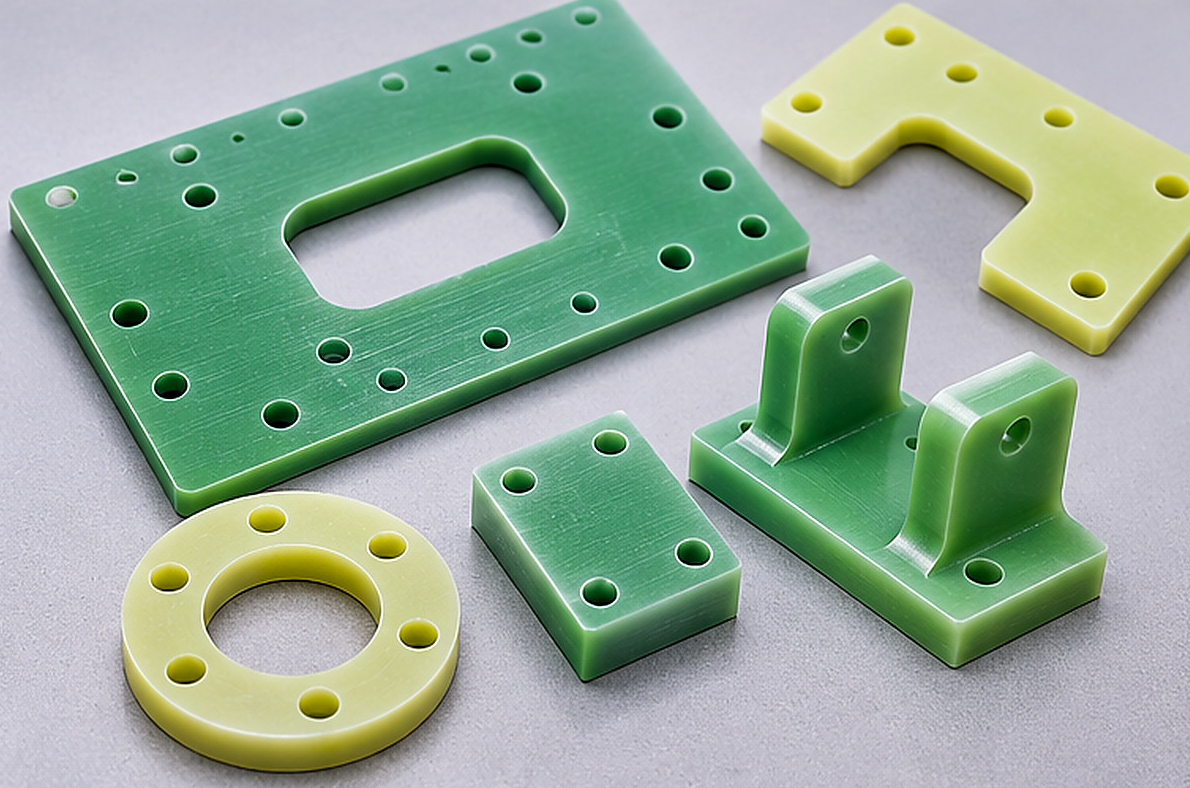
Yes. Both FR4 and G10 can be processed using suitable CNC machining methods to manufacture custom insulation and structural components.
Typical machining operations include:
- CNC Milling: Creating pockets, slots, external profiles, and stepped features.
- CNC Drilling: Producing mounting holes and other functional openings.
- CNC Routing: Cutting profiles and openings in laminate sheets.
- Edge Finishing: Removing suitable burrs and improving edge condition after machining.
The exact machining approach depends on material thickness, reinforcement structure, geometry, tolerances, production quantity, and available tooling.
Unlike many unfilled engineering plastics, glass-epoxy laminates contain abrasive glass reinforcement. Tool wear, dust generation, and edge damage therefore require particular attention during machining.
Important CNC Machining Challenges
1. Abrasive Glass Reinforcement
The glass fibers in FR4 and G10 can accelerate cutting-tool wear. Tool selection, cutting conditions, and replacement schedules should therefore account for the abrasive nature of these materials.
The appropriate tooling strategy depends on the operation and production requirements rather than one universal set of cutting parameters.
2. Edge Chipping and Delamination
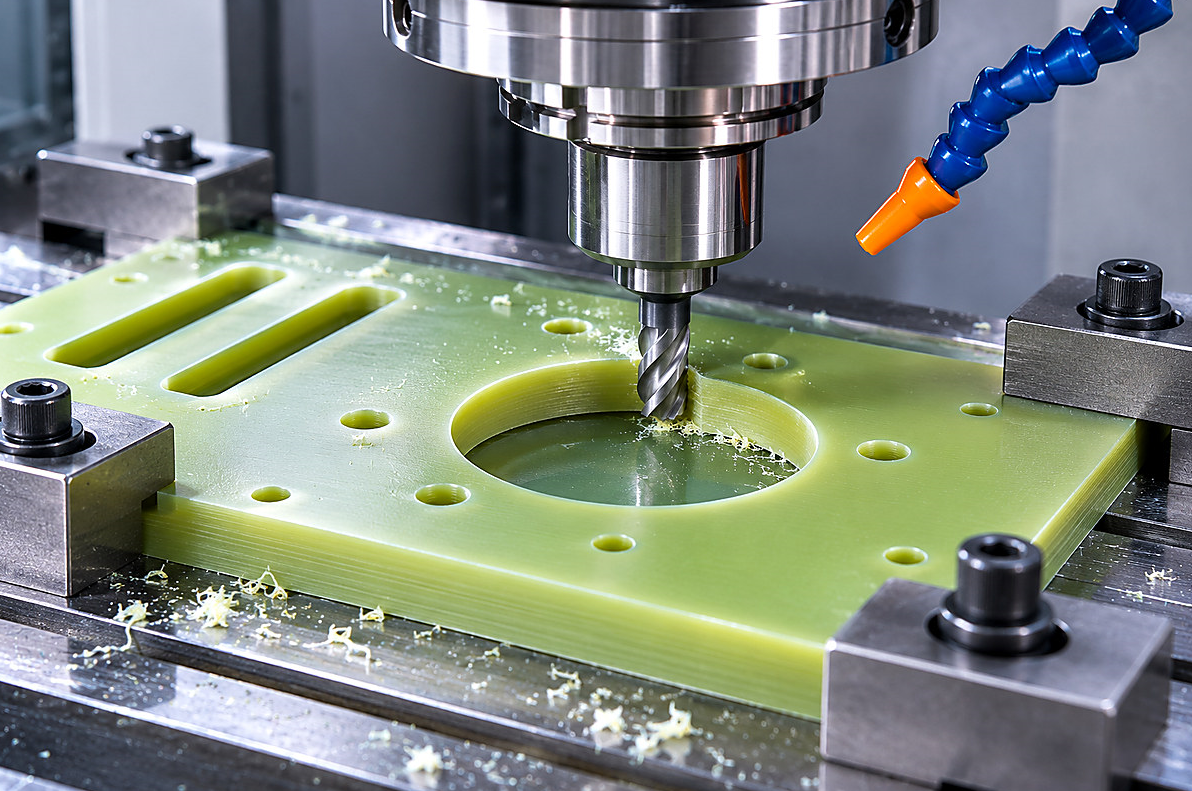
Because FR4 and G10 have layered composite structures, poorly supported cutting or drilling operations may produce chipped edges, breakout, or localized delamination.
Suitable workholding, controlled machining conditions, and support near critical features can help reduce these risks.
3. Machining Dust
Cutting glass-epoxy laminate can generate fine particles from the glass reinforcement and resin system.
Appropriate dust extraction, machine protection, and workplace safety measures are important. Dust-control methods should be selected according to the actual process and material safety information.
4. Dimensional Consistency
Part thickness, laminate orientation, tool condition, workholding, and machining strategy can influence dimensional consistency.
Critical dimensions should be specified clearly on the drawing, with inspection requirements established according to the function of the finished part.
Design Tips for Custom FR4 and G10 Parts
Allow Practical Internal Corner Radii
Conventional milling cutters have a finite diameter, making perfectly sharp internal corners difficult to produce.
Where possible, allow suitable internal radii and confirm that narrow slots or pockets are accessible with practical cutting tools.
Support Thin Sections and Features
Thin sections, narrow ribs, and small features near unsupported edges may require additional care during machining and handling.
Maintaining suitable material around holes and cutouts can improve part robustness. Exact minimum dimensions should be evaluated for the selected material grade and geometry.
Consider Laminate Orientation
Glass-epoxy laminates may have different properties in the plane of the layers and through the thickness.
For components subjected to mechanical loads, designers should consider how the laminate orientation relates to the actual direction of loading.
Features that introduce significant through-thickness or peeling loads deserve particular attention during design review.
Specify Functional Tolerances
Critical mounting holes, mating features, assembly dimensions, and component thicknesses should have clearly defined tolerances.
Applying unnecessarily tight tolerances to noncritical features can increase machining and inspection effort without improving the function of the part.
For custom components, a complete drawing and clear acceptance criteria are more useful than a general request for high precision.
Typical Applications of CNC Machined FR4 and G10
Depending on the selected material grade, FR4 and G10 may be used to manufacture a range of electrical and industrial components.
Examples include:
- Electrical insulation plates and barriers
- Mounting and support plates
- Insulating spacers and washers
- Terminal support components
- Test fixtures and positioning plates
- Custom structural insulation components
These parts may require accurate hole patterns, specific external profiles, controlled thicknesses, or assembly-related features.
The appropriate material should always be selected according to the functional requirements of the final component rather than appearance alone.
How to Choose Between FR4 and G10
When specifying FR4 or G10 for a custom CNC-machined part, start with the requirements that determine whether the component will function safely and reliably.
Useful questions include:
- Does the application require a defined flame-retardancy classification?
- What electrical insulation properties must the component meet?
- Will the part carry structural or assembly loads?
- What operating temperatures and environmental conditions are expected?
- Are there critical hole positions, thicknesses, or mating dimensions?
- Does the project require material certificates or inspection records?
These questions help narrow the material selection and reduce the risk of unnecessary substitutions or incomplete quotations.
What Information Should Be Included in an RFQ?
For custom FR4 or G10 CNC machining, complete project information helps the manufacturing team evaluate the part and prepare a more accurate quotation.
When possible, include:
- 2D engineering drawings and available 3D CAD files
- The specified FR4 or G10 grade and applicable material standard
- Required sheet thickness and overall part dimensions
- Order quantity and expected repeat-order requirements
- Critical tolerances and important assembly features
- Hole, slot, pocket, and external profile requirements
- Edge quality and surface requirements
- Electrical, mechanical, or flammability requirements that must be verified
- Inspection documentation and target delivery requirements
If the material grade is not yet finalized, explain the intended application and functional requirements so that possible options can be reviewed before a quotation is confirmed.
You can also explore our precision parts machining services for more information about custom component manufacturing.
Conclusion
FR4 and G10 belong to the same general glass-epoxy laminate family, but they should not be treated as identical material grades.
FR4 is associated with flame-retardancy requirements, while G10 is used in various electrical and structural applications where its specified characteristics are suitable.
For CNC-machined insulation parts, material grade selection, laminate orientation, tooling considerations, edge quality, and functional tolerances all deserve attention.
Mailake supports custom CNC machining projects involving industrial materials and precision components. If you are sourcing FR4 or G10 parts, please contact our team with your drawings and project requirements for evaluation and quotation.