



- Home
- >
- Blog
- >
- Materials & Finishes
- >
- CNC Machining of Phenolic Laminates: Design Tips for Insulation Parts
CNC Machining of Phenolic Laminates: Design Tips for Insulation Parts
Phenolic laminates are widely used in electrical insulation and industrial assemblies. Depending on the resin system, reinforcement, and material grade, they can provide a combination of electrical insulation and mechanical properties for custom components.
When a project requires mounting holes, slots, profiles, stepped features, or other custom geometries, CNC machining offers a practical way to manufacture phenolic laminate components from sheet or other stock forms.
However, phenolic laminates behave differently from metals and standard thermoplastics. Understanding their material structure, machining characteristics, and design limitations can help engineers reduce manufacturing risks and improve part quality.
What Are Phenolic Laminates?
Phenolic laminates are thermoset composite materials made by impregnating reinforcement materials, such as paper or cotton fabric, with phenolic resin and curing them under heat and pressure.
Different reinforcement systems and material grades have different mechanical, electrical, and physical properties. Common categories include:
- Paper-based phenolic laminates, commonly used for electrical insulation and general industrial components.
- Cotton fabric-based phenolic laminates, used in applications where different mechanical and structural characteristics are required.
- Other specialized phenolic laminate grades designed for particular industrial requirements.
Bakelite is a well-known historical trade name associated with phenol-formaldehyde resin. The term is sometimes used informally to describe phenolic materials, but it should not be treated as a universal name for every phenolic laminate.
For CNC-machined components, engineers should identify the actual material grade and reinforcement type rather than relying on the general material name alone.
Can Phenolic Laminates Be CNC Machined?
Yes. Phenolic laminates can be processed using suitable CNC machining methods, depending on the material grade, stock form, part geometry, and dimensional requirements.
Common machining operations may include:
- CNC Milling: Producing external profiles, pockets, slots, and stepped features.
- CNC Drilling: Creating mounting holes and other functional openings.
- CNC Routing: Cutting custom shapes and profiles from laminate sheets.
- CNC Turning: Machining suitable round stock into cylindrical components.
CNC machining is particularly useful when components require multiple features, accurate hole positioning, or geometries that cannot be achieved through simple sheet cutting.
The appropriate machining process should be selected according to the material structure, component geometry, production quantity, and required dimensional accuracy.
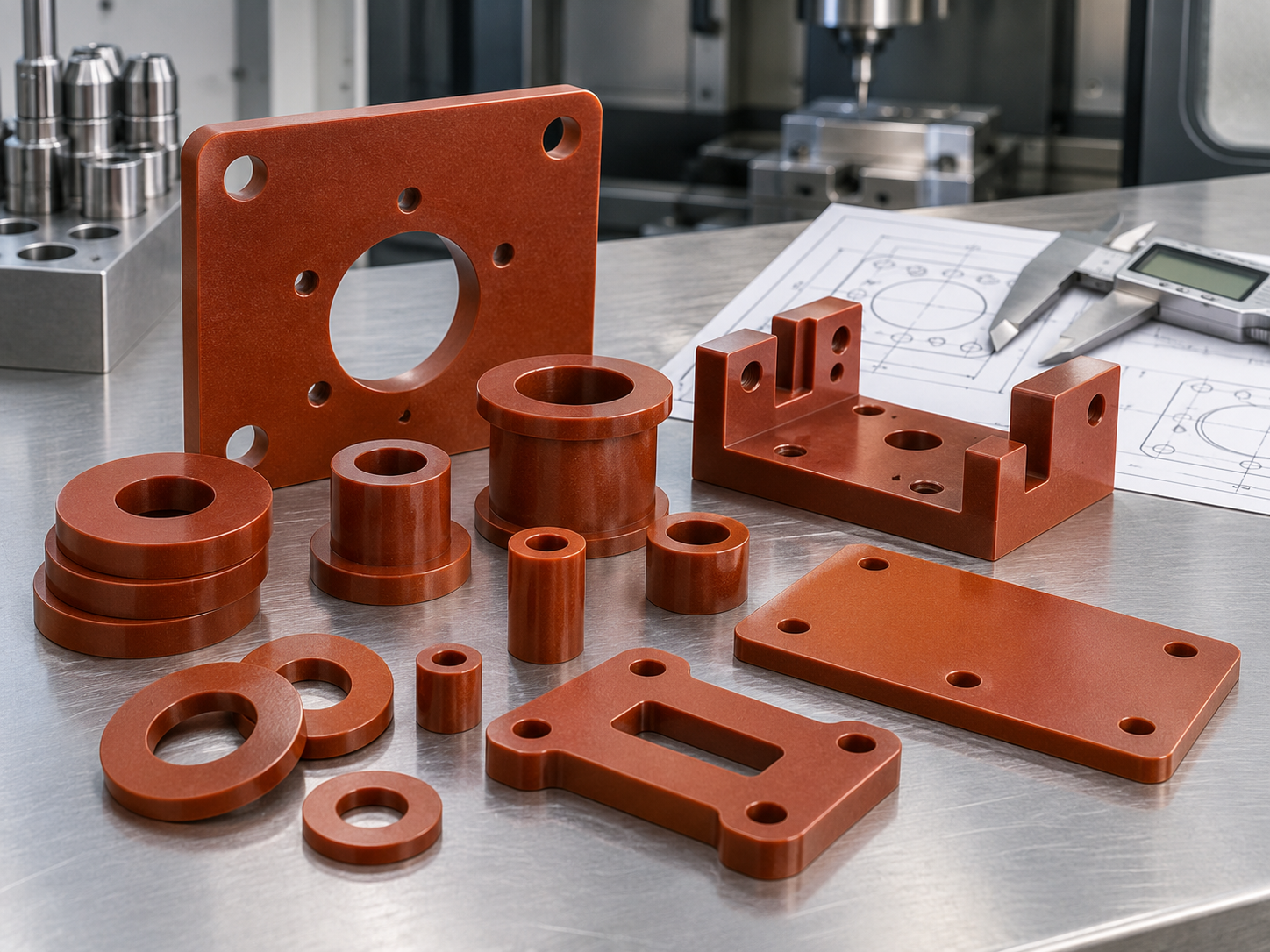
Key Design Considerations for CNC Machined Phenolic Parts
1. Select the Correct Material Grade
Material selection is one of the most important steps in designing phenolic components.
Paper-based and fabric-based phenolic laminates should not automatically be treated as interchangeable. Their mechanical characteristics, electrical properties, and suitability for different working environments can vary.
Before production, confirm the material grade, reinforcement type, required thickness, and relevant technical data sheet.
2. Avoid Extremely Thin or Unsupported Features
Phenolic laminates are reinforced composite materials. Thin walls, narrow ribs, and unsupported sections may be more vulnerable to chipping or damage during machining and handling.
Where possible, maintain sufficient material around holes, slots, and external edges. Practical wall thicknesses and suitable structural support can help improve manufacturing reliability.
3. Consider Internal Corners and Tool Geometry
CNC cutting tools have a defined diameter, which means perfectly sharp internal corners are generally difficult to produce through conventional milling.
Designers should consider practical internal radii that match the available cutting tools. This can simplify machining and reduce unnecessary toolpath complexity.
For parts with narrow slots or complex internal profiles, confirm tool accessibility before finalizing the drawing.
4. Define Functional Tolerances Clearly
Not every dimension on a phenolic component requires a tight tolerance.
Focus on critical features such as mounting hole positions, slot dimensions, component thickness, and assembly interfaces. Unnecessarily tight tolerances across all dimensions may increase manufacturing difficulty and cost.
When dimensional accuracy is important, clearly identify critical dimensions and inspection requirements on the engineering drawing.
5. Pay Attention to Edge Quality and Surface Condition
Phenolic laminates have a layered material structure. Depending on the grade, cutting direction, tool condition, and machining process, edges may be susceptible to chipping or localized damage.
To improve the finished component, machining plans should consider suitable workpiece support, sharp cutting tools, stable cutting conditions, and appropriate deburring methods.
If the component is used in an electrical assembly, edge condition and surface cleanliness should also be considered during design and inspection.
Common Applications of CNC Machined Phenolic Components
Phenolic laminates are used in a variety of electrical, mechanical, and industrial applications. Their suitability depends on the specific material grade and operating environment.
Typical custom-machined components include:
- Electrical insulation plates and barriers
- Insulating spacers and washers
- Mounting plates and support blocks
- Terminal support components
- Industrial fixtures and positioning components
- Custom insulating brackets and structural parts
These components often require customized dimensions, mounting holes, slots, and other functional features. CNC machining makes it possible to manufacture parts according to specific engineering drawings.
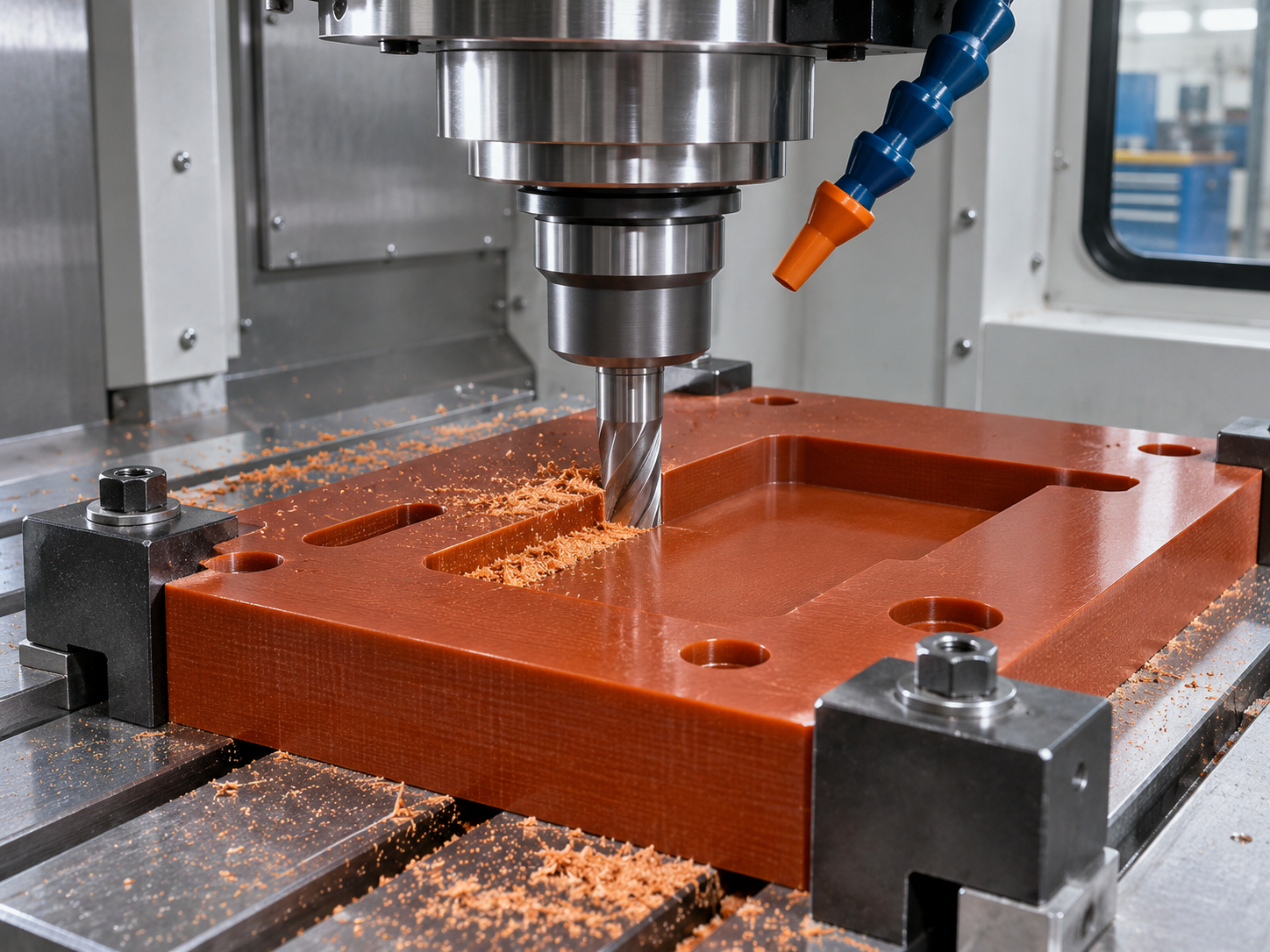
Common Machining Challenges and Process Considerations
Although phenolic laminates can be CNC machined, their composite structure requires appropriate process control.
Manufacturing considerations may include:
- Tool Wear: Cutting tool selection and condition can influence edge quality and dimensional consistency.
- Heat Generation: Excessive cutting heat should be avoided to reduce the risk of surface damage.
- Edge Chipping: Suitable workpiece support and machining strategies help reduce localized damage.
- Dust Control: Phenolic machining generates dust, so appropriate extraction and workplace protection measures are important.
- Dimensional Consistency: Material grade, thickness variation, clamping, and machining conditions should be considered together.
Machining parameters should be selected according to the actual material grade, cutting tool, machine setup, and component geometry. A single set of cutting parameters should not be assumed to apply to every phenolic laminate.
What Information Should Be Included in a CNC Machining RFQ?
Providing complete technical information helps manufacturers evaluate machining feasibility and prepare more accurate quotations.
When requesting a quotation for custom phenolic components, engineers and purchasing teams should ideally provide:
- 2D engineering drawings or 3D CAD files
- Specified phenolic material grade and reinforcement type
- Material thickness and overall dimensions
- Required production quantity
- Critical dimensional tolerances
- Hole, slot, and profile requirements
- Surface finish and edge quality requirements
- Application environment and assembly requirements, where relevant
If complete engineering drawings are not available, reference photographs, sketches, and basic dimensional information can also help suppliers understand the project.
Conclusion
CNC machining of phenolic laminates is a practical manufacturing solution for many custom electrical insulation and industrial components.
Successful production depends on selecting the appropriate material grade, designing practical geometries, defining functional tolerances, and controlling machining conditions.
By considering these factors during the design and quotation stages, engineers and purchasing teams can reduce unnecessary manufacturing difficulties and improve the reliability of custom phenolic components.
Mailake provides custom CNC machining services for various industrial materials and components. If you have engineering drawings, CAD files, or specific project requirements, you are welcome to contact Mailake for machining evaluation and quotation.