


- Home
- >
- Blog
- >
- Materials & Finishes
- >
- POM CNC Machining: Design Tips for Custom Acetal Parts
POM CNC Machining: Design Tips for Custom Acetal Parts
POM CNC machining is widely used for custom plastic components that need good wear performance, consistent dimensions, and reliable fit in mechanical assemblies. POM, also called acetal or polyoxymethylene, is often selected for guides, spacers, bushings, and inspection fixtures. It machines well, but that does not mean every POM part is straightforward to produce.
Material grade, wall thickness, clamping pressure, cutting heat, and inspection conditions can all affect the finished result. This guide explains what engineers and purchasing teams should consider when designing and sourcing custom CNC machined POM parts.
What Is POM, and Why Is It Used for CNC Machined Parts?
Polyoxymethylene (POM) is a semi-crystalline engineering thermoplastic known for its stiffness, low friction, wear performance, and relatively low moisture absorption. These characteristics make it useful for moving components and close-fitting mechanical parts.
POM can be supplied as sheet or rod stock and machined into parts based on drawings or CAD models. Common examples include locating blocks, conveyor guides, bushings, rollers, spacers, and automotive checking-fixture components.
However, dimensional stability is relative. POM generally expands more with temperature than metals, and it can deform under excessive clamping force or machining heat. Tolerances therefore need to reflect part geometry, material grade, and operating conditions rather than a single universal number.
POM-C vs. POM-H: Which Grade Should You Specify?
The two main types of unfilled acetal are POM-C (copolymer) and POM-H (homopolymer). Both are machinable, but their properties are not identical.
- POM-C (acetal copolymer): Generally offers better resistance to hot water and certain chemicals, with a lower tendency toward centerline porosity in stock shapes. It can be a practical choice for components exposed to moisture or chemical contact, provided the exact grade is suitable.
- POM-H (acetal homopolymer): Generally offers higher stiffness and strength than comparable unfilled POM-C grades. Delrin® is a brand of POM-H, not a generic name for every acetal plastic.
These are general material-family differences, not guarantees for every product. Filled, modified, or proprietary grades may perform differently. If your drawing specifies a particular grade or trade name, do not substitute another acetal without engineering approval.
How Is POM CNC Machined?
CNC Milling
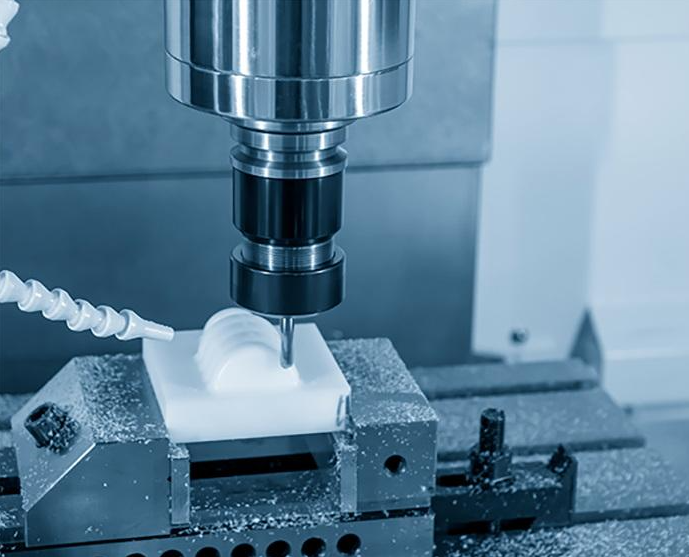
CNC milling is commonly used to create flat faces, pockets, slots, contours, mounting features, and locating surfaces. It is especially relevant to fixture blocks, guides, and plate-shaped components. Sharp tools, suitable workholding, and effective chip removal help reduce unwanted heat and surface damage.
CNC Turning
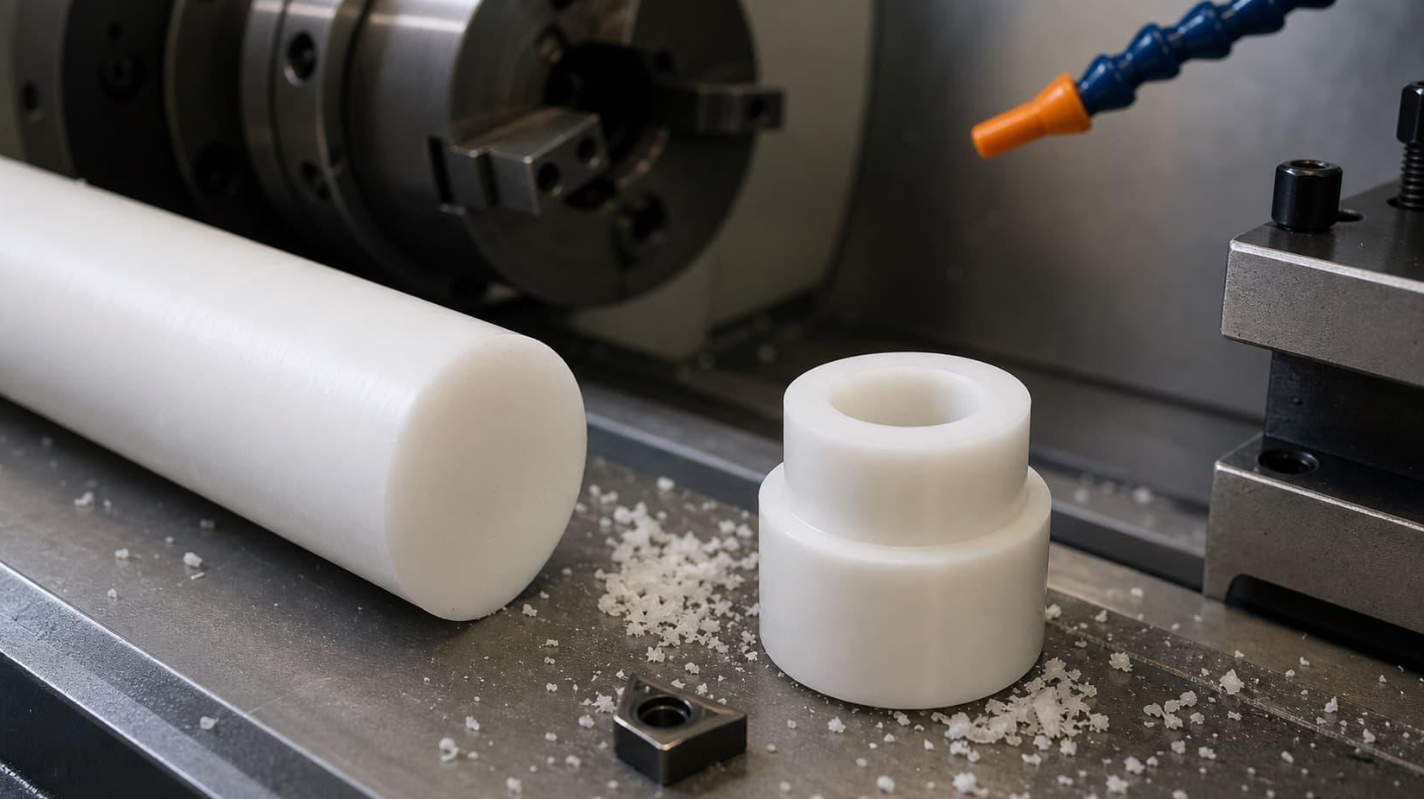
CNC turning is suitable for mainly round POM parts, including rollers, bushings, sleeves, and spacers. Long or slender features may need additional support because a plastic workpiece can deflect under cutting or clamping loads.
Drilling, Threading, and Deburring
Drilled holes and threaded features require attention to chip evacuation and heat buildup. Deep holes may need a different cutting and cooling approach from shallow holes. For highly loaded or frequently assembled threads, the design may need additional engagement length or a suitable insert, subject to engineering review.
Deburring should be specified where edges interact with mating parts, seals, or sliding surfaces. The appropriate method depends on feature access and the risk of damaging critical dimensions.
Common POM Machining Challenges
Heat and Dimensional Change
Plastics conduct heat less effectively than metals. Excessive heat from cutting can affect the surface and temporarily change part dimensions. Sharp cutting tools, appropriate machining conditions, and effective chip evacuation are important. Cooling methods should be selected for the operation and the actual POM grade, rather than applied automatically to every part.
Clamping Pressure and Thin Walls
Excessive fixture pressure may leave marks or deform a POM workpiece. Thin walls and long unsupported sections are particularly sensitive. Broad support, controlled clamping, and a machining sequence suited to the geometry can help reduce these risks.
Residual Stress and Warping
Removing a large amount of material from one side of a sheet or block may release internal stress and affect flatness. For demanding geometries, a staged roughing and finishing process may be appropriate. The stock condition and any need for stress relief should be reviewed for the selected material, not assumed for every order.
Design Tips for Custom POM CNC Parts
Good design for manufacturability (DFM) starts with the actual function of the component. Consider these points before releasing a drawing:
- Identify critical features. Apply tighter tolerances to functional interfaces, locating holes, and mating surfaces where necessary, rather than assigning the same tight tolerance to every dimension.
- Support thin sections. Avoid unnecessarily thin walls, long unsupported features, or severe thickness changes when the function allows a more robust geometry.
- Review internal corners. Milling tools leave an internal radius. Specify sharp internal corners only when functionally required and discuss how they will be produced.
- Consider temperature. If the part operates over a broad temperature range, evaluate thermal expansion and the resulting fit with adjacent components.
- Define hole and thread requirements. State which holes are for clearance, locating, press fits, or fasteners, and identify repeated assembly or load requirements.
- Plan inspection. Identify critical dimensions and any measurement conditions that matter to assembly and acceptance.
For an example of the part type this guidance applies to, see Mailake's custom CNC machined POM automotive checking fixture base.
Typical Applications of CNC Machined POM Parts
- Automotive inspection fixtures: Locating blocks, contour supports, and components used to position or check manufactured parts.
- Industrial automation: Conveyor guides, sliding blocks, wear strips, and machine locating elements.
- Mechanical assemblies: Bushings, spacers, rollers, and other components where friction, wear, and fit matter.
- Equipment and tooling: Custom brackets and non-metallic fixture elements manufactured to a defined drawing.
Whether POM is appropriate for an application depends on loads, temperature, chemical exposure, expected service life, and the specific grade. Material selection should be verified against the operating requirements.
What to Include in a POM Machining RFQ
A clear request for quotation helps the manufacturer evaluate machining feasibility and provides a better basis for comparing offers. Include the following where available:
- Current 2D drawings and/or 3D CAD files, including drawing revision.
- Material specification: POM-C, POM-H, a named grade, or an approved alternative.
- Quantity, including prototype and expected repeat-order volumes.
- Critical dimensions, tolerances, mating features, and inspection requirements.
- Surface condition, deburring, marking, or insert requirements, if applicable.
- Relevant operating conditions such as temperature, wear, chemical exposure, or repeated fastening.
- Delivery destination and target schedule.
If you are comparing manufacturing routes or require several precision features, review our precision parts machining services for a starting point.
Frequently Asked Questions
Is Delrin the same as POM?
Delrin is a trade name associated with POM-H (acetal homopolymer). POM also includes copolymer grades, so the terms should not be treated as interchangeable on technical drawings.
Can POM be CNC machined to tight tolerances?
Yes, but achievable tolerances depend on material grade, stock condition, part size, geometry, workholding, and inspection conditions. A drawing review is necessary before confirming a tolerance for a specific component.
Is POM-C always better than POM-H?
No. POM-C may be preferred for certain chemical or hot-water exposures, while POM-H may be preferred where greater stiffness or strength is needed. The decision depends on the part's actual service conditions and the selected grade.
Request a Quote for Custom POM CNC Machined Parts
Mailake supports custom CNC machining projects based on customer drawings and technical requirements. If you need POM fixture blocks, guides, spacers, or other precision components, share your material specification, drawings, quantities, and critical requirements so the team can review the project.
Contact Mailake to discuss your custom POM machining requirements.